Message from the Director, Executive Officer, Executive Vice President & CTO
September 2026
Amid a rapidly changing business environment,
we will evolve the technological foundation that
supports our competitive advantage and
create new value
through the power of data and science.
Organizational Structure and Technology Strategy to Strengthen “Oishisa Design” toward Evolution into a Comprehensive Solution Designer
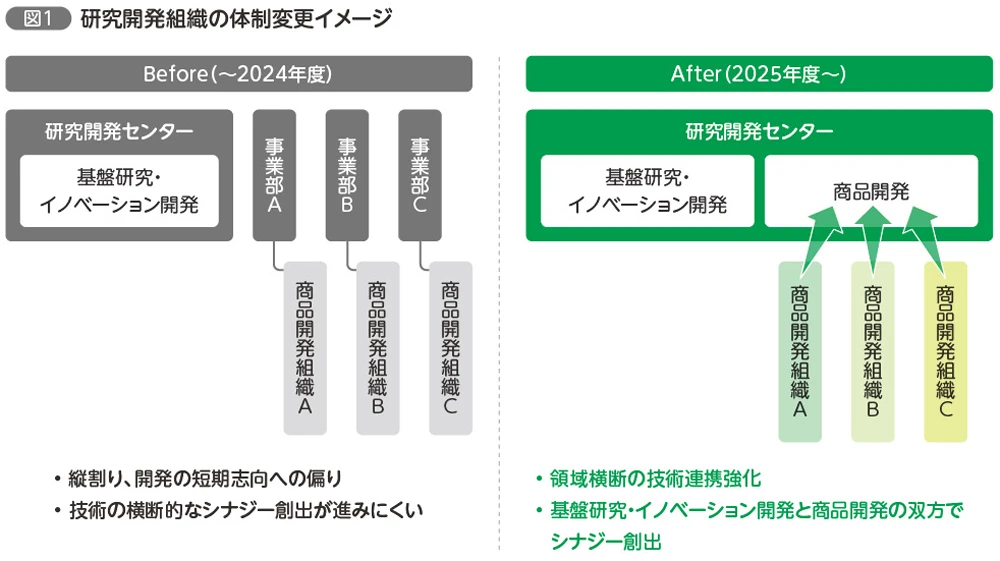
Previously, the Group consolidated its basic research and innovation development functions in the Research & Development Center, while product development was organized under individual business departments. Although this structure offered the advantage of quickly incorporating market and business needs, it also presented challenges: development tended to focus on the short term, organizational silos between business departments became more pronounced, and it was difficult to promote the cross-functional use of technologies, limiting opportunities to create synergies. In light of these challenges, we reorganized our structure in April 2025 and consolidated our R&D functions in the Research & Development Center. This has strengthened cross-domain technological collaboration and transformed our organization into one that fosters synergies among basic research, innovation development, and product development.
We have also decided to consolidate our three previously dispersed R&D sites in Kawasaki City, Kanagawa Prefecture, in January 2027, thereby promoting greater collaboration through their physical integration. Under the new structure, we have repeatedly discussed opportunities for synergy creation and technology themes in overlapping and adjacent domains, while identifying R&D themes that could lead to future products and services. We have clarified our development themes in areas such as long-lasting oil and other business-use oils and fats, health-conscious household-use products, functional starches, and business-use processed oils and fats. We view our ability to begin development spanning multiple domains from FY2026 as a major step forward.
By visualizing R&D expenses and profit contributions for each theme, we have made the relationship between inputs and outputs clearer. While many themes have produced a certain level of results, differences between themes have also become apparent. In areas where sufficient results are not yet in sight, the accuracy of initial sales-volume and cost forecasts remains an issue, and we intend to steadily improve this. At the initial stage of each R&D theme, there is room to improve the accuracy of our market assumptions and the way we define the intended business outcomes. We will therefore enhance the accuracy of theme selection by deepening engineers’ understanding of the business and making greater use of AI and other technologies. For innovation domains, recognizing that results tend not to emerge in the short term, we evaluate them using criteria different from those applied to product development, placing emphasis on the quality of outcomes and their future value.
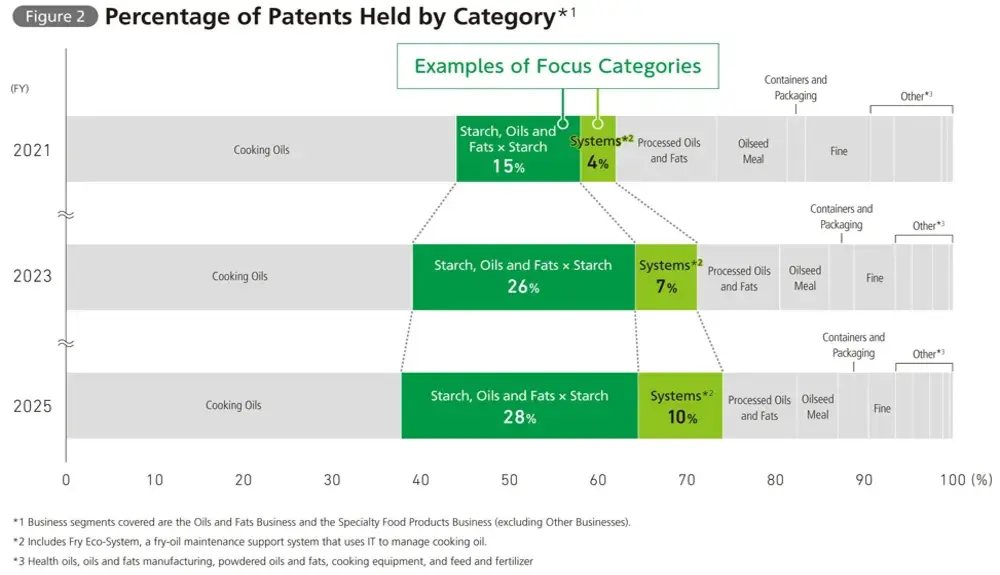
In addition, as part of the growth strategy under the Sixth Medium-Term Business Plan, strengthening our technological foundation centered on “Oishisa Design” has led to qualitative improvements in our intellectual property that serves as a source of competitive advantage. Accurately understanding the status of intellectual property enables us to identify the strengths and weaknesses of both the Group and our competitors, clarifying the categories in which we can leverage our strengths and the areas requiring further enhancement. By combining these insights with the direction of our businesses, we will continue building an intellectual property strategy linked to our management strategy. Going forward, we will further enhance the quality of our intellectual capital through investment in new and focus categories, as well as more accurate theme selection.
To realize “Evolution into a Comprehensive Solution Designer” in the future, we are strengthening “Oishisa Design” in two directions. The first is to build a scientific foundation for delivering our solutions that address customer needs. Beyond addressing identified issues, we will connect these efforts to the creation of new value. The second is to break down and quantify the factors that constitute “good taste” and define its essential nature. By making proposals based on quantitative data, we aim to uncover latent needs. In this area, in addition to in-house development, we are strengthening collaboration with academia, including universities, and expect these efforts to generate results. Looking beyond oils and fats and starches to expansion into other materials and fields, we will explore further possibilities for broadening our business domains by providing “good taste,” an essential value for people.
Strengthening the R&D talent that supports these efforts is also essential. By identifying each individual’s competency level, providing education based on those levels, and rotating talent in accordance with career development programs, we are developing talent capable of bridging foundational research and product development, while fostering the integration of knowledge through cross-domain assignments and exchanges. We will also involve intellectual property personnel from the early stages of development, thereby developing talent capable of taking an integrated approach to development and intellectual property and accumulating intellectual capital.
Production System for Ensuring Stable Supply
Because production sites involve substantial fixed assets, we emphasize efficient operation from the perspective of ROE and restrain unnecessary investment. However, excessive efficiency measures can increase the risk of production stoppages in unforeseen circumstances, potentially having an adverse impact on earnings. We therefore make investment decisions based on achieving both stable supply and asset efficiency. We are reassessing the aging of our facilities and reviewing capital expenditure priorities, while increasing maintenance investment to a certain extent from FY2026. By focusing investment on necessary facilities, we will reduce risk and minimize costs while strengthening our stable supply system. For the Group, our production sites are the very foundation of our businesses and an important element supporting one of our materialities, “Realizing a Sustainable Society through Stable Food Supply.” Amid rising geopolitical risks, the mutual backup provided by maintaining multiple sites contributes to stable supply.
Sustainability Initiatives from Both Defensive and Offensive Perspectives
The Group is working to achieve sustainable procurement throughout the supply chain, with initiatives to reduce environmental impact and respect for human rights as fundamental premises. Under the leadership of the Sustainability Committee, which I chair as Director, Executive Officer, Executive Vice President & CTO, we work in coordination with the Risk Management Committee, chaired by the Representative Director, President & CEO, to appropriately identify and manage risks under a companywide management framework. In particular, we have advanced traceability and dialogue with suppliers, raising the traceability rate to palm plantations to 83.0% and the percentage of suppliers that have signed consent forms for our Sustainable Procurement Policy and Standards to 95.8%.
At the same time, based on our belief that sustainable business activities can also create growth opportunities, we will begin full-scale discussions from an opportunity perspective in FY2026. The SAF (sustainable aviation fuel) we are developing using unused biomass has the potential to become a new business. Meanwhile, by replacing food resources such as soybeans and rapeseed used in SAF production with unused raw materials, we believe it can also contribute to the stable supply of edible oils. In addition, products based on the concept of “low burden” set out in the Group’s vision for the future—“Joy for Life—Bringing Joy to the Future by Food: Bringing joy to people, society, and the environment by good taste, health, and low burden”—have already contributed to reducing both environmental and work burdens. In particular, given our view that increased workloads caused by labor shortages are a major social issue, we will further develop and expand sales of products and services that address this issue by utilizing technologies such as “SUSTEC.”
Enhancing Corporate Value through dX
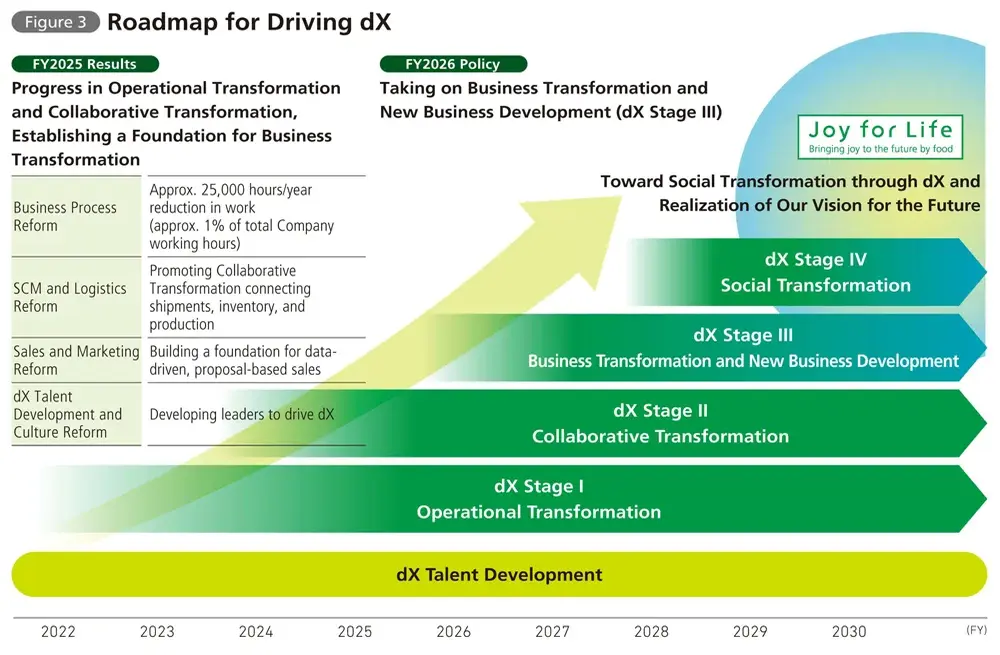
After I was appointed dX Promotion Leader in FY2024, the Group organized dX into Stages I through IV and has been advancing initiatives in stages.
In FY2025, we achieved results mainly in dX Stage I, Operational Transformation, and Stage II, Collaborative Transformation. Through business process reform initiatives across all departments companywide, we reduced working hours by approximately 25,000 hours annually, equivalent to approximately 1% of total Company working hours. In SCM and logistics reform, we optimized inventories and improved production efficiency by reviewing systems, delivery mechanisms, and inventory management. In sales and marketing, we improved the efficiency of sales activities and advanced the use of information through the introduction of SFA (sales force automation) and information retrieval systems. In Talent Development, we provided IT education, including for management, to raise overall dX and IT literacy. We also regard obtaining DX Certification as an achievement that demonstrates the Group’s initiatives externally. In FY2026, we will combine digital technologies such as AI with the Group’s assets to drive Business Transformation and New Business Development under dX Stage III.
Digital technology is a means; the objectives are Business Transformation and providing value to society. We write “dX” with a lowercase “d” because we view digital technology not as an end in itself but as a means of contributing to social transformation through Business Transformation and realizing our vision for the future. By combining digital and other tools with the Group’s technologies, we will create new value to sustainably enhance corporate value and provide value to society through business transformation and social transformation.