
Technology Development
We are studying food science, focusing on oils and starches, in order to create new value in terms of taste, health, and low impact. We are also working on developing new materials with a view to solving problems faced by our customers and society.
Fundamental Technology
Eliminates oiliness
If you feel an oily taste or smell in your mouth, the deliciousness of food is halved. Our unique technology suppresses the production and action of the compounds that cause oiliness and oily smell, achieving a "non-oily" texture and flavor, and we are working to eliminate the oily taste by researching and developing oils that are suited to foods.
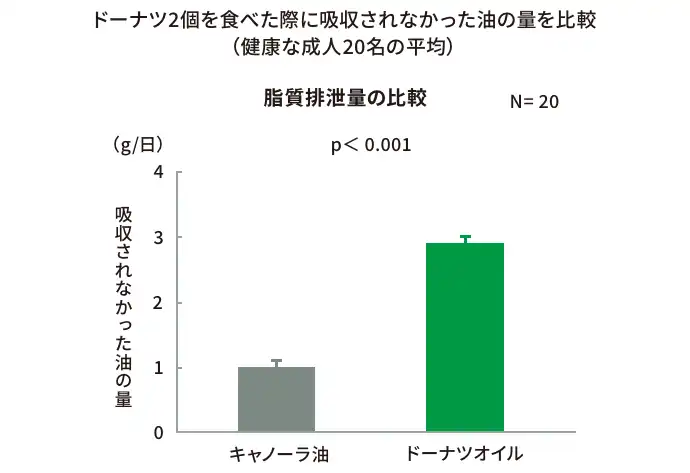
Effect of frying oil on doughnut characteristics
We identified the important factors in the deliciousness and tearing (oil staining) of donuts and investigated the frying oil suitable for donuts. After evaluating various frying oils, we found that the melting point of the frying oil is related to the amount of oil staining in donuts, and the solid fat content at 30°C is related to the oiliness and dry texture. We found that oils with a melting point of approximately 40°C or higher and a solid fat content of about 20% at 30°C are suitable for donuts in terms of physical properties and sensory characteristics.
Furthermore, when the absorbability of an oil with the above characteristics was evaluated in humans, it was revealed that it was less absorbed into the body than canola oil (liquid oil).
(Journal of the Japanese Society for Food Science and Technology 61, 346-352, 2014)
Improving health value
Research findings (e.g., research into vitamin K2 intake)
What is Vitamin K2 (Menaquinone-7)?
Vitamin K was originally discovered as an essential vitamin for maintaining blood clotting, but in recent years it has been discovered to play a variety of roles in the body. In particular, it is becoming increasingly important as an essential component for maintaining bone health. The main forms of vitamin K that can be obtained from food are vitamin K1, found in green vegetables, and vitamin K2 (menaquinone-7), which is found in large amounts in natto.
Many people believe that calcium is essential for healthy bones, but even if you try hard to ingest calcium alone, it will not reach your bones. This is because the calcium you ingest must be transported to the bones and make the bone-building protein (osteocalcin) work properly. Vitamin K is the only vitamin that can activate this bone-building protein.
Clarification of effective dosage
ビタミンK2がオステオカルシンを活性化し、骨の健康に役立つことは知られていましたが、最低限どの程度の量を摂取すれば効果が得られるのかは良くわかっていませんでした。そこで、日本人ボランティアの方々にご協力いただき、この疑問を解明する研究を行いました。通常の食事に加えて、ビタミンK2(メナキノン-7)を毎日100μg摂取すれば骨を作るタンパク質の機能を保ち、骨の健康状態を維持・改善できることを明らかにしました。(Journal of Nutritional Science and Vitaminology Vol. 61 (2015) No. 6 p. 471-480 日本人での詳細な研究は我々J-オイルミルズが初めて行いました)
In Japan, where the population is aging, bone fractures due to osteoporosis are one of the main causes of bedriddenness. We would like to raise awareness of the importance of proactively taking vitamin K2 to maintain and improve bone health, and contribute to maintaining health through diet.
Research and development on safety and security (e.g. trans fatty acids)
近年、健康志向の高まりや科学的知見の蓄積に伴い、お客さまにとって脂質に関する情報が食品を選択する上で重要な指標となっています。脂質に関連するハザードの一つにトランス脂肪酸が挙げられますが、当社ではお客さまにより一層の安心・安全を提供するため、政府・業界団体の指針でもあるトランス脂肪酸の低減に継続的に取り組んでいます。
一般的に、マーガリン類はトランス脂肪酸を多く含む食品と言われていますが、当社ではマーガリン類の原料となる油脂の開発や組み合わせ、独自の乳化技術などを活用して、マーガリン類としての機能 (塗りやすさ、おいしさ)と両立してトランス脂肪酸の低減に取り組んでいます。また、マーガリン類に限らず、その他製品についても原料の見直しや素材開発、生産条件の最適化などに取り組んでおり、お客さまの更なる安心に貢献できるように、トランス脂肪酸の低減に努めています。
Collaboration both inside and outside the company
In order to create new value, in addition to our own research, we actively conduct collaborative research with universities and other research institutions.
当社は2019年4月から、東北大学大学院農学研究科と食用油の酸化に関する共同研究講座(J-オイルミルズ 油脂イノベーション共同研究講座)を開講しています。
In this joint research course,
- To understand the components produced by various oxidation reactions of fats and oils by establishing new analytical techniques for lipid peroxides produced by the oxidation of fats and oils and the secondary oxidation products that result from them.
- To understand the key points of events that occur during oxidation, clarify the points that should be controlled, and explore new application possibilities for fats and oils.
is our main objective.
As a result of their research to date, the joint team has developed several methods for detailed analysis of oxidized fats and oils, and has succeeded in understanding the complex reactions to a certain extent. Going forward, they will further elucidate the oxidation mechanism and the properties of the oxides, aiming to establish and strengthen oxidation control technology.
By deepening our joint research with Tohoku University, we hope to unlock the potential of edible oils and fats and further contribute to "reducing environmental impact" and "preserving food resources," two issues that we position as important.
In addition to applying the technologies we develop in a timely manner to our products, we also output our findings in the form of academic conferences and research papers, thereby contributing to technological advances throughout society.
Analysis of oxides in fats and oils
Fats and oils contain various antioxidants, but it is difficult to understand their behavior. In this study, we succeeded in establishing a method for analyzing trace amounts of tocopherol hydroperoxide and tocopheryl quinone, which are produced by the oxidation of tocopherol (vitamin E), a typical antioxidant found in fats and oils, using a tandem quadrupole mass spectrometer.
This research has enabled us to understand the behavior of antioxidants in fats and oils, which had not previously been understood in detail, and we believe that this will provide important insight into understanding and controlling lipid oxidation.
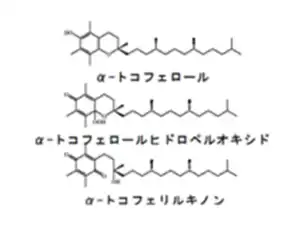
タイトル:Analysis of oxidation products of a-tocopherol in extra virgin olive oil using liquid chromatography-tandem mass spectrometry.
著者:Rena Tanno, Shunji Kato, Naoki Shimizu,Junya Ito, Shuntaro Sato, Yusuke Ogura, Masayoshi Sakaino,Takashi Sano, Takahiro Eitsuka, Shigefumi Kuwahara, Teruo Miyazawa, Kiyotaka Nakagawa
掲載誌:Food Chemistry 306 (2020) 1 25582 DOI:https://doi.org /10.1016/j.foodchem.2019.125582